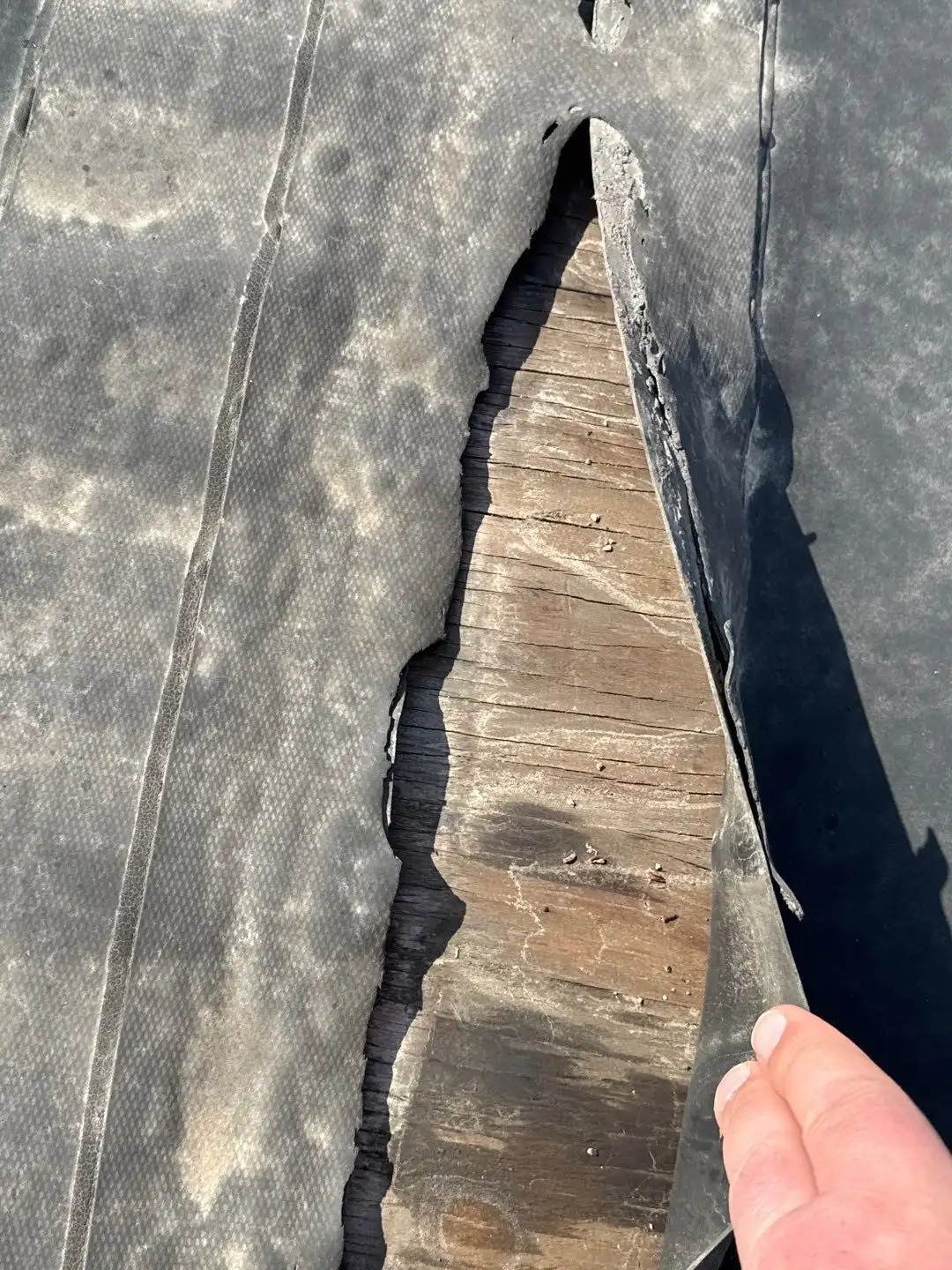
Seams and penetrations: more leak prone details
Beyond flashings, seams and penetrations are major failure points, and for a Mars Hill owner, understanding why they leak clarifies more common causes. Both involve interruptions in the membrane that must be sealed.
Why seams leak
Seams, where membrane sheets join, can leak because the join is a potential weak point, particularly on aging roofs or where the original welding or adhesion was imperfect, and over time seams can open, lift, or fail. The joins are inherently more vulnerable than the continuous sheet. For a roof, seams leak as these joins age and are stressed, gradually losing their integrity, which is why they are a common leak source on membrane roofs and need inspection to catch the opening or lifting before it lets water through.
Why penetrations leak
Penetrations, where pipes, vents, and equipment pass through the roof, leak because each is a point where the membrane is interrupted and sealed, and those seals can fail over time, opening a path for water. Every penetration is a potential leak point. For a Marion County roof, penetrations leak as the seals around them age and are stressed, and because there are often many penetrations, they collectively represent a significant leak risk, which is why the seals at each need attention to keep the roof watertight at these interruptions.
Equipment curbs and rooftop units
The curbs and seals around rooftop equipment are a particular subset of penetrations that leak, since the equipment sits on the roof with seals that can fail, and these areas often see foot traffic and stress that work against the seals. Rooftop units concentrate leak risk. For a Mars Hill roof with rooftop HVAC and other equipment, the curbs and seals around the units are a common leak source, which is why these areas, with their seals and the traffic around them, warrant particular attention in preventing leaks at the equipment.
Preventing seam and penetration leaks
Preventing leaks at seams and penetrations means inspecting them regularly for signs of failure and addressing problems, resealing or repairing failing seams and penetration seals, before they leak. Attention to these details keeps them watertight. For a roof, regular inspection and maintenance of the seams and penetrations, catching the opening, lifting, or seal failure early, prevents the leaks they would otherwise cause, which is why these details, as top failure points, need ongoing attention to keep the roof watertight.
Seams and penetrations as leak sources
Seams and penetrations, both interruptions in the membrane that must be sealed, are top leak sources because those seals and joins are stressed and age over time, and preventing leaks there means inspecting and maintaining them. For a Marion County owner, understanding these as major failure points focuses attention on the details where the membrane is interrupted, catching problems before they cause the leaks these points commonly produce.
Get your roof's seams and penetrations inspected
Finally, the most reliable defense against leaks is consistent maintenance of the failure points, since the lifting flashing or opening seam caught early is a minor fix while the same problem ignored becomes a leak and the damage it brings. A owner who keeps the flashings, seams, penetrations, and drainage maintained prevents most leaks before they start, protecting the roof and the building. That ongoing attention to the vulnerable points, more than any single repair, is what keeps a commercial roof watertight over its life.
It also helps to recognize that a leak's interior location rarely points straight up to its source, because water travels along the deck and structure before it appears inside. A Marion County owner who understands this knows that finding a leak means tracing it back to the responsible failure point on the roof, not patching the ceiling spot beneath it. That distinction, between where water appears and where it enters, is why proper leak repair starts with diagnosis at the failure points, which is what produces a lasting fix rather than a recurring problem.
The broader point about roof leaks is that they are far more predictable than they seem, since the same handful of failure points, flashings, seams, penetrations, drainage, and damage, account for the great majority of them. A Mars Hill owner who understands this can focus attention where it matters rather than worrying about the roof at large, concentrating inspection and maintenance on the vulnerable details. That focus, on the points where leaks actually start, is what makes leak prevention practical and effective rather than a matter of hoping the roof holds.
Finally, the most reliable defense against leaks is consistent maintenance of the failure points, since the lifting flashing or opening seam caught early is a minor fix while the same problem ignored becomes a leak and the damage it brings. A owner who keeps the flashings, seams, penetrations, and drainage maintained prevents most leaks before they start, protecting the roof and the building. That ongoing attention to the vulnerable points, more than any single repair, is what keeps a commercial roof watertight over its life.
It also helps to recognize that a leak's interior location rarely points straight up to its source, because water travels along the deck and structure before it appears inside. A Marion County owner who understands this knows that finding a leak means tracing it back to the responsible failure point on the roof, not patching the ceiling spot beneath it. That distinction, between where water appears and where it enters, is why proper leak repair starts with diagnosis at the failure points, which is what produces a lasting fix rather than a recurring problem.
The broader point about roof leaks is that they are far more predictable than they seem, since the same handful of failure points, flashings, seams, penetrations, drainage, and damage, account for the great majority of them. A Mars Hill owner who understands this can focus attention where it matters rather than worrying about the roof at large, concentrating inspection and maintenance on the vulnerable details. That focus, on the points where leaks actually start, is what makes leak prevention practical and effective rather than a matter of hoping the roof holds.
Finally, the most reliable defense against leaks is consistent maintenance of the failure points, since the lifting flashing or opening seam caught early is a minor fix while the same problem ignored becomes a leak and the damage it brings. A owner who keeps the flashings, seams, penetrations, and drainage maintained prevents most leaks before they start, protecting the roof and the building. That ongoing attention to the vulnerable points, more than any single repair, is what keeps a commercial roof watertight over its life.
Mars Hill Commercial Roofing inspects and maintains the seams and penetrations on Mars Hill commercial roofs, catching the failures that cause leaks. Call (765) 676-3491 to get these vulnerable details inspected. Attending to the details is what separates a watertight roof from an expensive surprise.